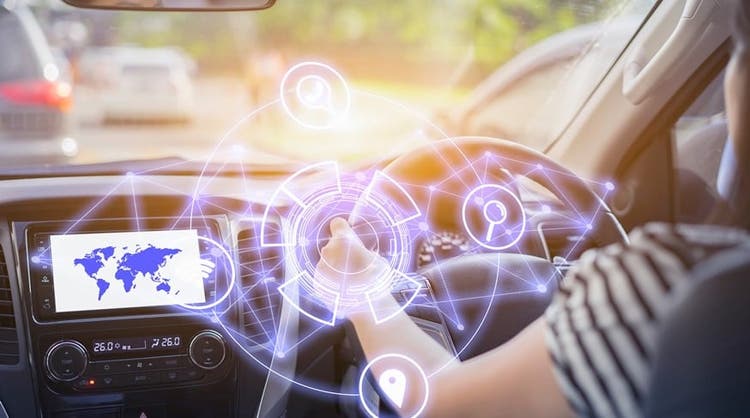
From the pages of sci-fi novels and movie scripts, self-driving or autonomous cars are finally a reality and are taking space on the roads. This has been possible by leveraging advanced technologies such as GPS sensing knowledge, sensors and other equipment used to manage driving. However, to be truly effective, autonomous cars need detailed maps of roads that clearly display obstacles and other hazards. Such maps are highly-critical because even the most sophisticated sensors are not enough to help a car navigate through changing environments safely enough while letting the occupants relax or doze off.
Digital maps help by providing insights into the vehicle’s computer, and wherever required; they add redundancy to the vehicle’s knowledge of the situation it faces. For example, radar and cameras do not always recognize a stop sign if people are standing in front of it or the sign has been vandalized. On the other hand, when a map knows that there is a sign ahead, the sensors simply need to verify it. The load on sensors and processors is also reduced with this support.
While map data is one of the key assets that will help autonomous cars in the future, these self-driven vehicles are very new to map usage, and that raises the expectations on the design of these maps.
For efficiency in autonomous driving, the maps must be:
- Accurate in allowing the localization of vehicle to its environment
- Detailed by including various navigation and localization data such as traffic signs, lanes and buildings
- Up-to-date with ease and flexibility of live updates on critical information
- Accessible by being available in all driving conditions and drivable areas
- Compact with capability of efficient data transfer for localization and updates
Baidu, China’s largest search company, believes that in times to come, smart maps for autonomous vehicles will be a bigger business than web search.
Enablers like machine learning (ML) and artificial intelligence (AI) will help in better map generation and improvement of map scalability for driverless cars. These techniques, together with deep learning algorithms generate huge data and analytics for navigation map makers enabling them to stay ahead in delivering competitive products for autonomous driving.
To make future driverless cars more efficient, the robotic methods employed by them deserve attention. The incorporation of sensor data processing in the Electronic Control Unit (ECU) of a car makes it important to improve the utilization of machine learning for optimizing maps. The potential applications can be an evaluation of driving scenario through data collection from various sensors including LiDARs and cameras.
AI can perceive real-world changes and update maps instantly for self-driving cars. Such navigation assistants can help autonomous cars deeply understand the world around them and take the right action to avert mishaps. Acknowledging the potential of this technology, Ford has already decided to invest $1 billion in AI.
ML and AI attributes can help the map systems in a driverless car to:
- Get updated in real-time enabling better decisions and improving the positioning of the vehicle
- Be high-definition, high-precision and 3D using LiDAR data, panoramic, mobile mapping, and other open sources
- Have micro accuracy from the real world with details of 3D lanes, road borders, guard rails, speed limits, and other traffic restrictions
- Have capabilities on deep learning algorithms and AI to identify real world changes
The ML and AI oriented high-definition maps will open new doors of opportunities for self-driven cars and enhance the efficiency of these vehicles
With our focus on accelerating digital transformation for industries, Cyienthelps clients get business outcomes and not just new tools and technologies. We collaborate with digital map developers to help them solve real world issues in the automotive sector and make self-driven vehicles safer and smarter.