
Hyperspectral imaging, a groundbreaking technology initially developed for remote sensing and industrial applications, has found its way across a spectrum of industries. This article explores the intricacies of hyperspectral imaging, delving into its principles and instrumentation, and dives deep into its applications, majorly focused on the healthcare industry. From environmental monitoring to disease detection and beyond, hyperspectral imaging has revolutionized our ability to capture and analyze spectral data, unveiling hidden insights that were once beyond our reach.
Better than human vision
Hyperspectral imaging is a non-invasive imaging technique that combines the power of spectroscopy and traditional imaging. Unlike conventional imaging systems that capture images in three or four spectral bands, hyperspectral imaging records data in hundreds of narrow, contiguous spectral bands. In conventional imaging, the human eye sees the color of visible light in mostly three bands—(long wavelengths (perceived as red), medium wavelengths (perceived as green), and short wavelengths (perceived as blue). Spectral imaging divides the spectrum into many more bands. This technique of dividing images into bands can be extended beyond the visible spectrum range.
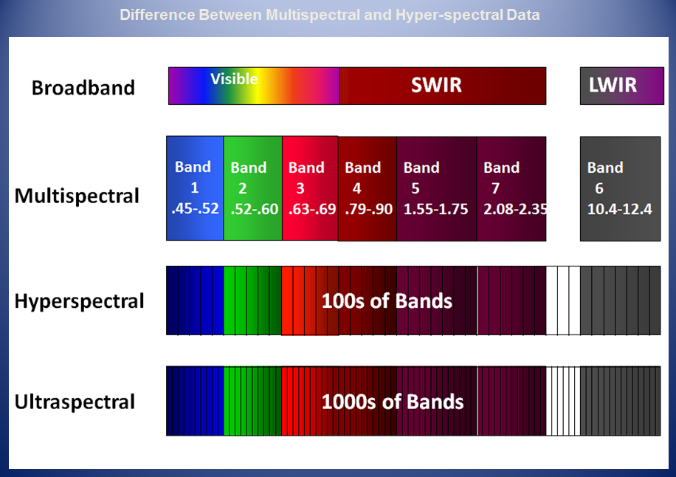
In hyperspectral imaging, the recorded spectra have fine wavelength resolution and cover a wide range of wavelengths. Hyperspectral imaging measures continuous spectral bands, as opposed to multispectral imaging, which measures spaced spectral bands. Hyperspectral imaging systems acquire images in over one hundred contiguous spectral bands., whereas multispectral imaging does so in under ten bands.
Reference: https://altigator.com/en/multispectral-and-hyperspectral-drone-imagery/
Principles of hyperspectral imaging
Conventional imaging captures a scene in only a few broad spectral bands, typically in the visible range (red, green, blue) and sometimes near-infrared. It provides limited spectral information and cannot distinguish between materials with similar colors in the visible spectrum.
In contrast, hyperspectral imaging explores the hidden territories of spectral data, capturing scenes across hundreds of narrow, contiguous spectral bands. This wealth of spectral information enables hyperspectral imaging to surpass the boundaries of human vision, discriminating materials with identical visual appearances and unveiling non-visual phenomena such as moisture content, heat, or chemical composition.
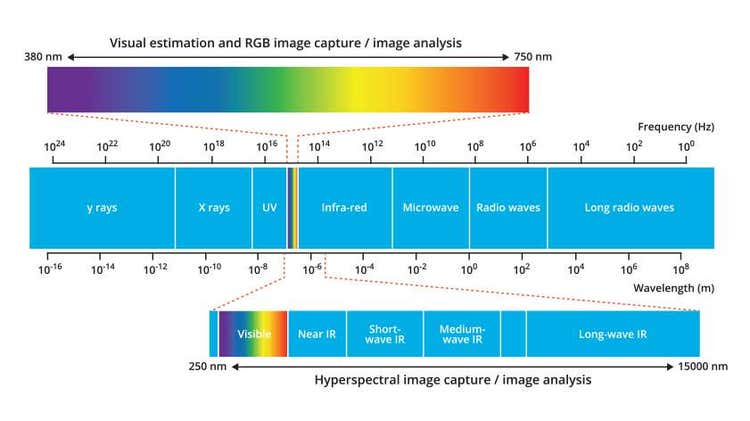
Hyperspectral imaging captures data across the electromagnetic spectrum, spanning the visible to the infrared and, in certain cases, extending into microwaves. This extensive spectral coverage equips hyperspectral imaging with the capability to identify materials based on their distinct spectral signatures. Spectral signatures are similar to fingerprints. Just as fingerprints are used to identify a person, unique spectral information helps in material identification, classification, and analysis.
Reference: https://www.specim.com/technology/what-is-hyperspectral-imaging
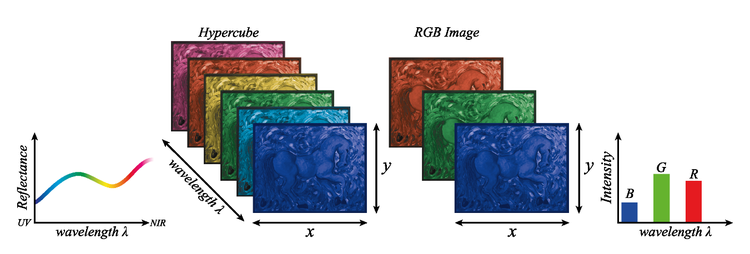
Hyperspectral imaging acquires the full continuous spectrum of light for each point (x, y) of the scene, resulting in a three-dimensional data cube as a function of (x, y, λ), where λ is the wavelength. We can imagine the data cube as a book with many pages. Each page can be considered as image data at a specific wavelength.
Reference: Hyperspectral Image Registration and Construction from Irregularly Sampled Data (Hannes Freij) https://liu.diva-portal.org/smash/get/diva2:1596253/FULLTEXT01.pdf
Using the data cube, it is possible either to extract the full spectrum from a pixel of the image or visualize the image at a specific wavelength. Using this information, we can answer the questions “what” based on the spectrum and “where” based on the location.
To analyze hyperspectral image data, we can leverage the power of AI to unlock deeper insights from complex spectral data. AI algorithms can identify subtle spectral variations, enabling accurate material identification, environmental monitoring, and disease diagnosis. By automating the analysis of hyperspectral data, AI-based approaches reduce the burden of manual interpretation, accelerate decision-making, and enhance the precision of results. This synergy between AI and hyperspectral imaging is poised to revolutionize industries such as agriculture, geology, medicine, and remote sensing, driving innovation and efficiency in data-rich applications.
Use cases
Spectral imaging has been applied to a wide range of scientific investigations at various scales, such as remote sensing, pigment determination in biology, medicine, coastal ocean imaging, water analysis, agriculture, cultural heritage and archaeology, and more. Here are a few use cases across industries.
Healthcare applications
Cancer detection:
- Early detection: Hyperspectral imaging can identify subtle spectral differences in tissues, aiding in the early detection of various cancers.
- Surgical guidance: During surgery, hyperspectral imaging helps surgeons identify tumor margins and healthy tissue, enabling more precise tumor removal.
Dermatology:
- Skin lesion analysis: Dermatologists use hyperspectral imaging to assess skin lesions, aiding in the diagnosis of conditions such as melanoma.
- Wound healing: It monitors wound healing progress by analyzing spectral changes in the affected area.
Neuroimaging:
- Enhanced visualization: Hyperspectral imaging enhances the visualization of brain structures and abnormalities, offering valuable insights for neurosurgeons and researchers.
Endoscopy:
- Gastrointestinal imaging: Hyperspectral endoscopy can detect and classify abnormalities in the gastrointestinal tract with enhanced sensitivity.
- Cancer screening: It aids in the early detection of colorectal and esophageal cancers.
Agricultural applications
Crop health monitoring:
- Early disease detection: Hyperspectral imaging can identify subtle changes in the spectral signatures of plants affected by diseases or pests. Early detection allows for timely intervention, reducing crop losses.
- Nutrient deficiency identification: It can pinpoint nutrient deficiencies in plants by analyzing their spectral responses, helping farmers optimize fertilizer application.
Precision agriculture:
- Yield prediction: Hyperspectral data can be used to predict crop yields by assessing plant health and growth throughout the growing season.
- Variable rate application: Farmers can precisely tailor irrigation, fertilization, and pesticide application based on the specific needs of different areas within a field.
Soil analysis:
- Soil composition: Hyperspectral imaging can determine soil composition and properties, including moisture content, organic matter, and mineral content, helping farmers make informed decisions about soil management.
- Soil erosion detection: It aids in identifying areas prone to soil erosion by analyzing soil spectral signatures, allowing for erosion control measures to be implemented.
Weed detection and management
- Weed identification: Hyperspectral imaging can distinguish between crops and weeds based on their spectral differences, enabling precise and targeted weed control.
- Reduced herbicide usage: By accurately identifying weeds, farmers can reduce herbicide usage, saving costs and minimizing environmental impact.
Crop maturity assessment
- Harvest timing: Hyperspectral imaging can determine the optimal time for harvesting crops by analyzing spectral changes related to crop maturity and quality.
- Fruit ripeness: In fruit orchards, it helps assess fruit ripeness, ensuring that fruits are picked at the right moment for market readiness.
Pest and disease management:
- Pest infestation detection: Hyperspectral imaging can identify pest infestations in crops, allowing for targeted pest management strategies.
- Fungal infection detection: It helps detect fungal infections in crops such as grapes or wheat, allowing for early treatment.
Mineral exploration and mapping
- Mineral identification: Hyperspectral imaging can accurately identify minerals based on their unique spectral signatures. This is particularly useful for prospecting valuable minerals such as gold, copper, and rare earth elements.
- Mineral zoning: It helps map the distribution of minerals within geological formations, aiding in the delineation of ore bodies and deposit boundaries.
Geological mapping
- Terrain analysis: Hyperspectral data can be used to create detailed geological maps by distinguishing between different rock types, formations, and geological structures based on their spectral characteristics.
- Fault detection: It aids in the identification of geological faults, fractures, and structural features that are crucial for understanding the geological history of an area.
Oil and gas exploration
- Hydrocarbon detection: Hyperspectral imaging can assist in the identification of hydrocarbon deposits by detecting hydrocarbon-related absorption features in the spectral data.
- Reservoir characterization: It helps characterize subsurface reservoirs, including porosity and mineral composition, to optimize drilling and extraction operations.
Environmental monitoring
- Water quality assessment: Hyperspectral imaging can be used to assess water quality by analyzing the spectral signatures of water bodies, identifying pollutants, and monitoring changes over time.
- Land degradation: It aids in monitoring land degradation, erosion, and soil composition changes caused by geological and environmental factors.
Remote sensing for geological surveys
- Aerial and satellite imaging: Hyperspectral sensors mounted on aircraft and satellites provide a broad perspective for regional geological surveys and environmental monitoring.
- Mineral resource management: Geologists use hyperspectral data from remote sensing platforms to assess the potential for mineral resources in large and remote areas.
Natural hazard assessment
- Landslide prediction: Hyperspectral imaging can be used to detect potential landslide-prone areas by analyzing terrain and soil conditions.
- Earthquake studies: It aids in studying fault lines and tectonic activity by analyzing geological features and changes over time.
Future trends—pushing the limits of data discovery
Challenges in hyperspectral imaging include data storage, processing complexity, and the need for advanced algorithms. However, ongoing technological advancements, including miniaturization and automation, are making hyperspectral imaging more accessible.
The future of hyperspectral imaging holds promise in fields such as autonomous vehicles, cultural heritage preservation, and space exploration, expanding its horizons and making the invisible spectrum more accessible than ever.
Hyperspectral imaging has transcended its origins and become a powerful tool with diverse applications across numerous industries. Its ability to capture and analyze spectral data has transformed how we monitor our environment, cultivate our crops, explore our planet, and even diagnose diseases. As technology advances, hyperspectral imaging will undoubtedly continue to illuminate the unseen spectrum and unlock new realms of knowledge and discovery.