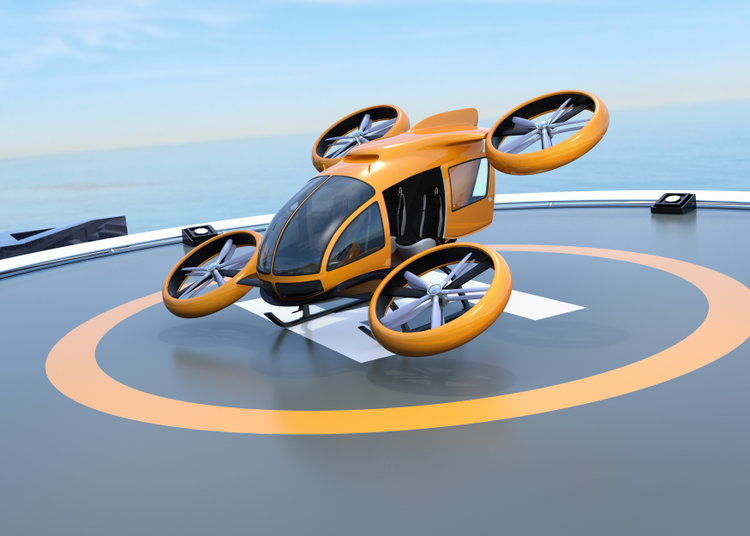
Urban Air Mobility (UAM) comprises electric vertical take-off and landing (eVTOL) aircraft capable of transporting passengers and cargo in an urban environment. This promises to revolutionize how people and goods move within and across cities, offering a faster, more efficient, sustainable, less noisy, and environmentally friendly alternative to traditional transportation methods. Though the concept implementation is in its early stages, a number of OEMs across the globe are already developing diverse eVTOL aircraft designs.
Newly emerging paradigm
With the proliferation of evolving technologies such as 5G, hyper-automation, AI/ML, and analytics in all walks of life, the UAM domain will not remain isolated. As with any other mode of transportation, UAM vehicles will also require regular maintenance to ensure they are safe and reliable. Artificial intelligence is bound to transform the way UAM aircraft are going to be maintained. This blog explores how AI can be used to improve UAM maintenance, its benefits, and the challenges that need to be overcome.
AI in UAM maintenance
AI can be used in several ways to improve UAM maintenance. Some of these include:
- AI-based predictive maintenance: AI algorithms for predictive maintenance of UAMs may be deployed to analyse data from sensors and other onboard sources to predict when the vehicle would require maintenance. This would allow maintenance teams to schedule maintenance proactively, reducing downtime and improving vehicle availability.
- AI-based maintenance inspections: UAM vehicles are complex machines that would require regular inspections to ensure they are safe and operational. AI can analyze images and other data collected during inspections to identify potential issues requiring attention. This could help maintenance teams to identify issues more quickly and accurately, reducing the risk of errors or oversights.
- AI-based decision-making to support maintenance: Maintenance decisions can be complex, and teams would need to consider multiple factors, such as the cost of repairs, availability of spare parts, and impact on vehicle availability. AI can analyze this data to provide recommendations to maintenance teams, helping them make more informed decisions.
- Autonomous maintenance systems: In the future, AI-powered autonomous maintenance systems could perform certain maintenance tasks on UAM vehicles without human intervention. For example, robotic systems equipped with AI algorithms could conduct routine inspections, perform minor repairs or component replacements, and conduct system checks. This could reduce human workload, increase maintenance efficiency, and enhance safety by minimizing human exposure to hazardous maintenance tasks.
- Diagnostics and troubleshooting: Should a UAM vehicle encounter an issue, AI could assist maintenance technicians in diagnosing and troubleshooting the problem. By analyzing sensor data, historical maintenance data, and technical manuals, AI systems can provide insights and recommendations to help technicians identify the root cause of the issue and suggest appropriate repair actions.
Operational safety and efficiency
The application of artificial intelligence in urban air mobility maintenance would offer several benefits towards significantly enhancing the efficiency, safety, and reliability of UAM operations. Here are some key advantages of using AI in UAM maintenance:
- Proactive maintenance: AI can enable predictive maintenance by analyzing large volumes of data from UAM vehicles. By identifying patterns and trends, AI algorithms can predict potential failures or maintenance needs before they occur. This would allow maintenance teams to take proactive measures, such as scheduling inspections or replacing components, before a breakdown happens. Proactive maintenance would reduce unplanned downtime, improve operational reliability, and minimize the risk of in-flight failures.
- Increased aircraft availability: Using AI to support maintenance, UAM operators would be able to improve vehicle availability, reduce downtime, and ensure that vehicles are safe and reliable. This would certainly help in increasing customer satisfaction while improving the overall performance of UAM operations.
- Cost reduction: AI-driven maintenance optimization would help UAM operators reduce operational costs. By accurately predicting maintenance needs and optimizing maintenance schedules, AI would support in minimizing unnecessary inspections and component replacements, reducing maintenance labor and material costs. Furthermore, by preventing unplanned downtime and optimizing fleet utilization, AI could maximize revenue generation and minimize financial losses associated with aircraft grounding.
- Improved safety: AI systems can continuously monitor the condition of UAM vehicles during operation, analyzing real-time sensor data for anomalies or potential safety risks. By detecting and providing early warning of system malfunctions or component failures, AI has the potential to help prevent accidents and ensure that maintenance issues are addressed before they pose a safety hazard, thus enhancing overall operational safety in UAM operations.
Data and integration challenges
Despite the benefits of AI in UAM maintenance, several challenges need to be addressed. One of the biggest is the quality and availability of data. AI algorithms rely on large amounts of data to identify patterns and make predictions. If the data is insufficient or of poor quality, the algorithm may not be able to make accurate predictions. UAM being an evolving domain at present, this aspect is of great relevance during initial days of operations.
Another challenge is about integrating AI with existing maintenance processes. UAM operators may have to consider integrating AI into their maintenance processes despite the challenges in bringing-in disruptive changes to their planned & established procedures.
Finally, there may be regulatory challenges that need to be addressed. Regulators may need to develop new rules and guidelines to ensure that AI is used safely and effectively in UAM maintenance. This will require close collaboration between UAM operators, regulators, and other stakeholders.
Evolving flight path
Incorporating AI in UAM maintenance can revolutionize the way aero-vehicles are maintained. By using predictive maintenance, improving inspection accuracy, and supporting maintenance decision-making, AI can help improve the safety, reliability, and availability of UAM vehicles. While challenges need to be addressed, the benefits of AI in UAM maintenance are significant, and we can expect to see further progress in this area in the coming years.