
The measurement of physiological parameters is critical in assessing an individual's health status. Given that physical, in-person examination is not always possible, contactless monitoring of vital signs may provide benefits in various fields of application, from healthcareand clinical settings to occupational and sports scenarios, as also sudden and serious life-threatening situations that occur in day-to-day activities.
Current technologies are working with sensors attached to individuals, which can be a source of failures and false alarms. Also, its success is determined by the individual and whether they wear the device constantly. Contactless health monitoring offers advantages that overcome all these challenges.
Contactless health monitoring technologies include remote camera (optical/ infrared), acoustic, and radio frequency (RF) sensors such as radar and Wi-Fi. While other technologies have advantages and limitations, RF technology has the merit of being robust, day/night capable, accurate, and devoid of privacy issues.
How RF technologies read health parameters
RF technologies for contactless health monitoring can be broadly classified into active and passive sensing technologies. Active sensing technologies involve the transmission of an RF wave directed toward subjects and sensing the parameters of the signal reflected from them (radar). Passive sensing technologies utilize the reflections of RF waves from the subjects already illuminated by RF signal sources from an omnipresent device such as Wi-Fi routers.
Sensing the health condition of a subject using RF technologies is fundamentally based on the extraction of signal parameters affected by the minute movement of the body or parts of the body such as arms, legs, heart, and lungs. This signal parameter is called micro-doppler information - the term “micro” reflects the fact that the Doppler frequency generated by minute body part movement is extremely low. The success of RF technologies in sensing human health parameters thus lies in using advanced signal processing methodologies to extract the correct micro-doppler information. Examples of the RF spectrum due to different movements are shown below.
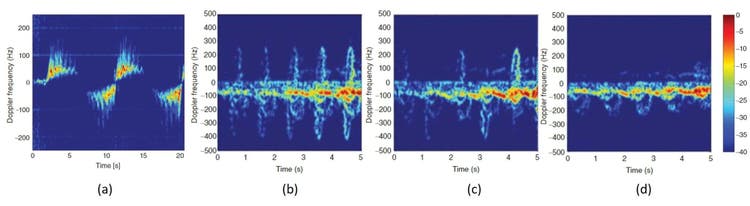
Figure 1: Spectrogram of human gait: (a) walking back and forth, (b) walking with no handbag, (c). walking with one handbag, (d) walking and holding two handbags with both hands (Source: Backscattering and RF Sensing for Future Wireless Communication, Online ISBN:9781119695721, 2021 John Wiley & Sons Ltd., pp. 157-177)
The application of RF technologies for contactless health monitoring includes monitoring of abnormalities due to diseases related to body movement, falls, sleeping disorders, and heart and respiratory rates. While walking behavior and abnormal body movements can reveal the presence of diseases like dementia or Parkinson’s disease, especially in the elderly, abnormal breathing patterns and heart rate can reveal unhealthy body conditions at any age, either as a long-term phenomenon or temporal observation. Examples of walking behaviors detected by RF sensors like radars are shown in Figure 1 above. Some examples of breathing patterns and heart rates are shown in Figure 2 below.
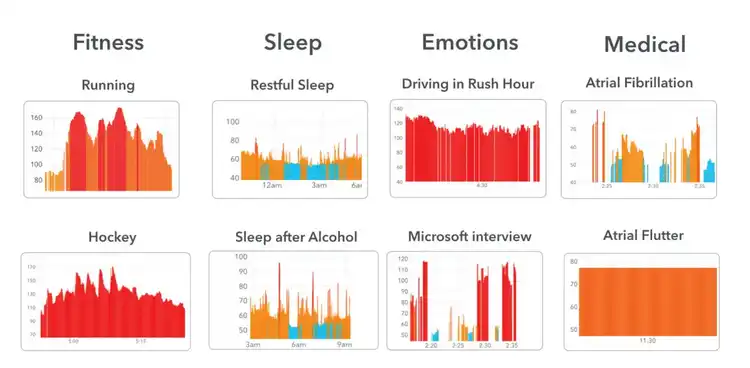
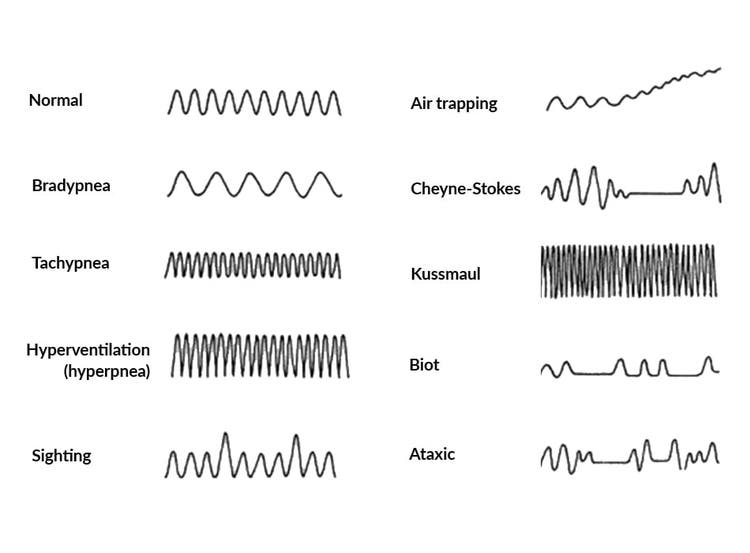
Contactless health monitoring using radar offers the advantage of amplifying the micro-doppler as radar for healthcare uses higher frequencies and hence Doppler frequencies are higher in value as compared to the reflection of a Wi-fi signal. A higher Doppler frequency helps to detect the signal parameters more easily. Extensive research is already in place for human respiratory and heart rate monitoring by radar, popularly known as “vital sign monitoring.” Vital sign monitoring has wide-ranging use cases across the automotive (in-cabin monitoring for occupant’s/ driver’s health) and healthcare sectors.
Navigating implementation challenges
The challenges of radar technology implementation are higher accuracy, false detection, implementation cost, and concerns about health hazards due to direct RF transmission toward the human body. The issues with higher accuracy and false detection are being addressed by advanced signal processing algorithms employing machine learning. To address the cost, semiconductor device manufacturers have developed a single-chip solution for complete radar hardware. Further, advanced signal processing techniques and robust waveform designs will help in reducing the transmit power.
Wi-Fi has the advantages of higher accuracy, omnipresence, and lower cost. A passive detection technique is used to capture the reflection of omnipresent Wi-Fi signals in a hospital/indoor environment or inside a moving vehicle and to analyze the micro-doppler for vital sign monitoring and monitoring other parameters such as body movements and falls. Additionally, RF Identification (RFID) is already being used for tracking patients inside a hospital or similar indoor setup.
Emerging scope for research
Contactless health monitoring using RF technologies has opened up an emerging research area to help healthcare professionals by providing early detection of probable severe health conditions, enabling them to treat the subjects faster and more effectively. Integration of RF sensors with a high-speed communication network will further enable the sharing of health data with designated health centers/medical professionals, enabling them to take necessary actions remotely till the subjects are attended to by professionals in person. Research is underway on developing efficient hardware and advanced algorithms to handle the ever-increasing complexity of health conditions and to overcome emerging challenges.