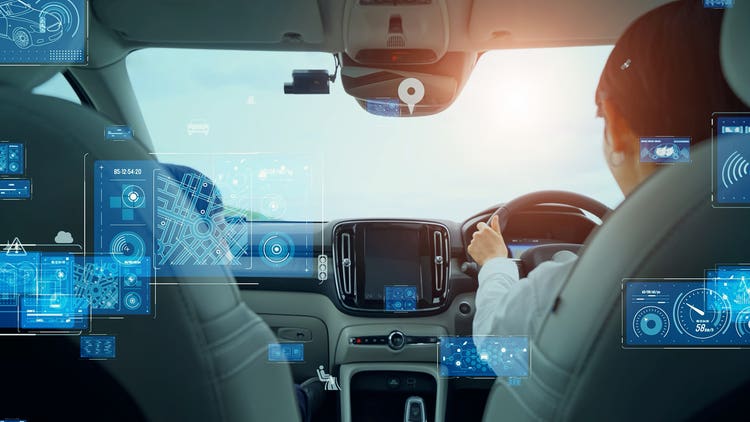
Off-road vehicles increasingly feature Advanced Driver Assistance Systems (ADAS). Several ADAS technologies, often adopted from conventional road cars, are making their way into off-road vehicles to improve their performance, safety, and efficiency.
Advanced driver assistance systems can significantly enhance safety and efficiency in off-road equipment, offering various benefits ranging from enhanced visibility and safety to remote monitoring and diagnostics.
- Enhanced visibility: Off-road environments often have poor visibility due to dust, mud, or other obstructions. ADAS systems such as cameras and sensors can provide operators with better visibility, especially in challenging conditions, reducing the risk of accidents.
- Remote monitoring and diagnostics: Some ADAS systems can provide remote monitoring and diagnostics capabilities, allowing fleet managers to track equipment performance, identify issues early, and schedule maintenance more efficiently, minimizing downtime and maximizing productivity.
- Improved safety: ADAS can help in off-road environments by providing features such as collision avoidance and blind-spot detection. These features help operators navigate rough terrain more safely by alerting them to potential hazards and helping them avoid collisions.
For tasks such as collision avoidance, blind spot detection, and automatic braking, depth estimation is a crucial component, discussed here in detail.
What is Depth Estimation?
Depth estimation refers to the process of determining the distance of objects in a scene from a particular viewpoint, which is crucial in functions like object avoidance, object detection, and navigation. Depth estimation maps combined with 2D or 3D object detection are employed in these functions.
Scenario:
Depth estimation in off-road vehicles needs to be robust while tackling an unstructured environment (without geometric clues such as lane marking that are available for on-road vehicles), impaired vision, sensor placement issues, and a far greater degree of freedom (pitch, yaw, and roll, whereas on-road vehicles mostly operate on a single plane).
Challenges in Off-Road Environments
- Uneven ground and slopes: Off-road terrain often includes uneven ground surfaces and varying slopes, which can lead to occlusions and incomplete scene assessment. Depth estimation sensors may struggle to maintain accurate depth measurements on sloped surfaces or areas with significant elevation changes.
- Unstructured textures and interference: Dense vegetation in off-road environments can obstruct sensor views, causing occlusions and interfering with depth estimation. Additionally, vegetation may exhibit complex structures and motion patterns that are challenging to capture accurately using depth estimation sensors. The lack of clear geometric patterns in terrains, vegetation, and rocks makes it difficult for algorithms to learn reliable depth cues.
- Illumination variations: Harsh sunlight, shadows, and dust can significantly impact image quality and hinder depth estimation accuracy. Transitions from open sunlight to shade or vice versa can lead to rapid changes in image intensity, posing challenges for real-time depth estimation.
Depth Estimation Methods
Some popular depth estimation methods are LiDAR, Radar, stereo matching, and monocular depth estimation.
LiDAR (Light Detection and Ranging): This is a commonly used technology for depth estimation in autonomous vehicles due to its high accuracy and reliability.
Advantages:
- LiDAR provides high-accuracy depth measurements, often with millimeter-level precision.
- It offers long-range detection capabilities, enabling early detection of obstacles and hazards.
- LiDAR is less affected by lighting conditions and can perform well in various environmental conditions.
Disadvantages:
- LiDAR sensors can be expensive, which may increase the overall cost of the ADAS/AD vehicle system.
- A limited vertical field of view may lead to occlusions and incomplete scene understanding in off-road environments.
- LiDAR's performance can be affected by adverse weather conditions such as dust, fog, rain, or snow.
Radar: Radar (Radio Detection and Ranging) is another technology commonly used for depth estimation in autonomous vehicles.
Advantages:
- All-weather performance: Radar is less affected by adverse weather conditions such as dust, rain, fog, or snow compared to other sensors like cameras or LiDAR. This makes radar reliable for depth estimation in various environmental conditions.
- Long-range detection: Radar sensors can detect objects at long distances, enabling early detection of potential hazards and obstacles. This capability contributes to safer navigation and allows ADAS/AD systems in vehicles to perceive their surroundings over significant distances.
Disadvantages:
- Lower spatial resolution: Radar generally provides lower spatial resolution compared to LiDAR, limiting the ability to precisely localize objects or discern fine details in the environment.
- Interference and clutter: Radar signals are susceptible to interference, leading to false detections or reduced accuracy in off-road settings with complex terrain and vegetation.
Stereo Matching: This method involves using two or more cameras placed at known separations to capture images. By analyzing the disparities between corresponding points in the images, the depth of information can be computed using triangulation.
Advantages:
- Depth estimation using stereo vision can be computationally efficient.
- It does not require additional sensors beyond cameras, which may reduce system cost and complexity.
- It can provide dense depth maps, offering detailed spatial information about the environment.
Disadvantages:
- Stereo vision relies on feature matching between stereo pairs, making it less effective in textureless or homogenous off-road environments.
- Accuracy can degrade with increasing distance from the camera, affecting performance in long-range scenarios.
- Calibration and alignment between camera pairs are crucial for accurate depth estimation, which can be challenging in rugged off-road conditions.
Monocular Depth Estimation: This method uses a single camera to estimate depth by using a neural network trained on large datasets that contain paired images and depth maps.
Advantages:
- Monocular depth estimation can leverage existing camera sensors without the need for additional hardware.
- It can be computationally efficient and suitable for real-time applications.
- Advances in deep learning have led to significant improvements in monocular depth estimation accuracy.
Disadvantages:
- Monocular depth estimation typically relies on learning from large datasets, which may require substantial computational resources for training.
- Accuracy may degrade in scenes with complex geometry or textureless regions.
- Monocular depth estimation may struggle with scale ambiguity, making it challenging to accurately estimate absolute distances without additional information.
Sensor Fusion: Combining information from multiple sensors, such as cameras, LiDAR, and radar, can improve depth estimation accuracy. Sensor fusion techniques integrate data from different sensors to create a more comprehensive and robust perception system.
Depending on the operating environment and budget, OEMs may choose which system to employ for their depth estimation.
Low Cost Approach:
Machine learning-based monocular depth estimation is suitable for offroad driving depth perception where cost and adaptability matter owing to their inexpensive setup and ability to adapt to different environments (depending on their training data). This method can act as a complementary sensor for a radar/LiDAR and stereo vision setup for sensor fusion.
Depth data is obtained from a stereo camera setup or LiDAR while operating in the said unstructured environment (where the vehicle will be deployed, e.g., images for self-supervised learning, sequences of images are taken) and then a neural network is trained on this data. Data augmentation is performed to increase the robustness of the model. Then, using transfer learning and hyperparameter tuning and testing, a depth estimation model is prepared. Later, during inference, pre-processing and post-processing techniques will help in robust depth estimation.
Monocular Depth Estimation Benefits:
- Cost-effectiveness: Machine learning-based monocular depth estimation is more cost-effective compared to LiDAR or stereo depth cameras. Training a depth estimation model requires a single camera, which is more affordable than the specialized hardware required for LiDAR or stereo vision.
- Simplicity: ML-based depth estimation simplifies the sensor setup by relying on a single camera. This reduces the overall complexity of the system, making it more suitable for applications with space, weight, and power constraints.
- Adaptability to existing hardware: ML-based depth estimation can be integrated into existing camera setups without significant modifications. This adaptability is advantageous for retrofitting existing vehicles or systems with depth perception capabilities.
- Flexibility across environments: ML-based models can be trained on diverse datasets, making them adaptable to various environments and terrains. This flexibility is valuable in scenarios where the vehicle operates in dynamic or unpredictable conditions.
- Real-time adaptation: ML-based depth estimation models can adapt in real time to changes in the environment. This is suitable for applications where the terrain conditions are dynamic, and the system needs to adjust quickly to varying depth information.
- Improved performance in low-texture environments: In scenarios with low-texture environments, where traditional stereo vision systems might struggle, ML-based depth estimation models continue to perform well. These models can learn to infer depth from contextual information.
- Integration with machine learning pipelines: ML-based depth estimation seamlessly integrates with broader machine learning pipelines. This allows for the fusion of depth information with other types of data, enhancing the overall perception and decision-making capabilities.
- Continuous learning and adaptation: ML-based models can be continuously improved and adapted by retraining them with new data. This adaptability is beneficial for systems that operate in evolving environments.
- Reduced dependency on external infrastructure: ML-based depth estimation does not rely on external infrastructure such as reflective markers (used in some LiDAR systems) or specialized stereo vision setups.
Machine learning-based monocular depth estimation methods are a viable option to be deployed in off-road vehicles for depth estimation owing to their adaptability and robustness, and for sensor fusion. OEMs can use monocular depth estimation to integrate with their pre-existing setup and improvise depth estimation through sensor fusion and as a fallback mechanism when a sensor fails.