Rail infrastructure is a tightly controlled and regulated system where coordination is crucial for trains to move safely and efficiently around the rail network grid. Today, this coordination is achieved through a mix of human and electromechanical equipment that human trains use by operators to manage traffic signalling. We need digital signalling-based coordination for tomorrow’s digital railway infrastructure, enabling robust and dynamic optimisation and densification techniques required for train traffic regulation and further automation of rail network mechanisms. This critical application relies on ubiquitous and consistent network connectivity while the train moves. Hence, the railway’s communication network is a crucial enabler for controlling and real-time monitoring of trains and maintaining safe, efficient operations.
Rail Networks have been allocated a dedicated spectrum for safety-critical and signalling operations; however, railway infrastructure and network managers are challenged to fulfil all their needs with only this available spectrum. While they can deploy a dedicated, stand-alone network using their allocated spectrum, an additional spectrum will be necessary to serve all the foreseen Future Railway Mobile CommunicationsSystem (FRMCS) applications and provide radio redundancy. One potential solution is for railways to collaborate with Telco Operators whose existing ORAN infrastructure can be reused. Railways and telcos are interested in building coverage along rail tracks. By sharing network infrastructure, they are primarily used for passenger connectivity and benefit from reduced Capex & Opex Infra investment.
Trends that are Shaping the Rail Industry Today!
The Rail Connectivity industry’s innovation has been witnessing steep growth. The year 2024 has seen widespread adoption of emerging technologies such as autonomous trains, Internet of Trains – train info, rail crossing, predictive monitoring, fleet management, AI/ML-based traffic management, rail yard operations, rail connectivity- automatic vehicle identification software for Locomotive’s, rail infotainment and onboard connectivity, decarbonisation – battery power and Hydrogen-fuel cells, digital passenger experience, rail automation -video-based track maintenance and high-speed rail, rail-ADAS-collision warning system, AR/VR, and big data/analytics. A combination of audio and visual smart signals in the form of alerts to train pilots and enable them to identify specific events or potential dangers. The differences between rail network scenarios and traditional GSM networks are analysed according to 5G-R requirements, unique physical environment, and propagation characteristics. Some critical challenges railway communications face are the Doppler Effect, RRM and CSI-Feedback, Handover, Efficient Energy Operation, Public Safety, Security and Regulatory Conformance. FRMCS is a global standard defined for railway communications and will replace the existing Global System for Mobile Communications (GSM-R), which will be replaced by 2030. The upgrade of GSM-R to FRMCS presents several challenges:
- Enabling a Smooth & Phrased Transition—The new FRMCS/5G system must work with and alongside GSM-R for several years. A deep understanding of the functionality of GSM-R and new FRMCS systems is required to ensure continued smooth operations.
- Old and new onboard systems: Old and new onboard systems, such as GSM-R and FRMCS/5G, exist, and a mixture of both technologies would be on the rail field network. OEMs will have developed FRMCS/5G systems to support both.
- Lack of Skilled Resources—Technical capability is the main priority for a smooth migration; an experienced, skilled workforce who understands GSM-R and FRMCS/5G intimately is needed.
While 5G is making waves for Train-to-Ground (T2G) connectivity, rail operators are launching dedicated gigabit wireless trackside networks to support high-speed broadband services, including remote video surveillance and passenger Internet access. T2G connectivity is enabled in the form of:
- Private 5G (P5G) connectivity that utilises a 5G SIM connected to telco operators via geographically distributed 5G base stations. A modernised onboard router connects through a rail-top 5G radio interface, engaging multiple telecom providers for robust connectivity. This setup can be expanded into a comprehensive FRMCS network.
- For ultra-fast connectivity, a dedicated mm-wave trackside network can be established using rooftop radios in the 5-95GHz range. Transceivers at both ends of the train connect to a single rail Internet operator, while 76GHz radar sensors on locomotives enhance connectivity and ensure collision avoidance.
Today, rail operators are challenged by a lack of skills to ensure the massive transformation of rail networks and their parallel running. This article will discuss the Rail-ADAS Collision Warning System, the Adoption of 5G and ATCS Signalling Systems, and a few challenges faced by 5G-R.
-
Rail ADAS-Collision Warning System
Rail-ADAS technology aims to provide an intelligent forward collision warning system to help prevent accidents and reduce delays. It can be extended to perform active braking. A combination of 76Ghz RADAR, LiDAR-2D/3D, and CAMERA can and enable forward collision warning systems for new and existing train systems. Using a combination of 5G mmTC+ sensors and urLLC+ object recognition, we conduct continuous and real-time scanning of the rail track environment to calculate the optimal reaction based on variable parameters.
-
Real-Time Collision Avoidance and Intelligent Decision-Making
Real-time collision avoidance and intelligent decision-making are key features of 5G that can enhance rail safety using the FRMCS or ORAN Network by applying AI/ML techniques on ATSC data fetched. The active braking system, guided by Rail-ADAS, improves overall safety by reducing the severity of collisions or avoiding them altogether.
-
Automatic Signalling and Speed Monitoring
ATCS Signalling enables automatic detection and interpretation of trains' intelligent signalling systems. Corresponding notifications are then sent to the Rail Pilot /Rail NoC and ADAS system for appropriate decision-making. Dynamic speed monitoring detects trains that are overspeeding to avoid potential derailments by remote auto braking. With the help of RAN cells, it calculates the optimal cruising speed and energy required to reach the next stop.
-
Perception-Based Systems
The development of a perception-based system extends these features addressed above. This system uses data obtained from Radar, LiDAR, Cameras, radio antennas, cell information, and track signature systems. Sensors monitor rail tracks, rolling stock, power systems, and environmental conditions.
-
5G-R and Data Integration
5G-R enables all this data to be seamlessly connected in real time. Combined with software analytics and machine learning, railway operators can perform preventative maintenance and predict failures and other events that could interrupt services. The high bandwidth provided by 5G-R allows for high-quality video for secure communications between operational personnel and improved situational awareness during emergency events, drone inspections, and other applications that generate video and high amounts of data.
-
Predictive Maintenance and Security
Using IoT data to predict maintenance requirements will increase the availability and productivity of rail assets. It will also facilitate higher standards of protection against both cybersecurity attacks and physical threats.
-
-
Adoption of 5G & Autonomous Train Control System (ATCS)
To ensure train safety operations, it is mandated and necessary to regulate the position and speed of trains and supervise all driving conditions. The train control system is supposed to achieve this feature. It has evolved from massive hardware and electrical devices to software-based mechanisms.
-
Communication-based train control (CBTC)
This technology automatically prevents collision by maintaining a safe distance from a preceding train. The CBTC system consists of onboard and wayside control units that ensure this safety. Highly reliable control units on the ground handle safety-related data. However, these wayside control units have operational flexibility limitations due to their control zones.
-
Autonomous Adaptive Train Control System (A-ATCS)
An Autonomous ATCS rain Control System), based on 5G communication ensures safe train movement without centralised wayside control units. Trains share their dynamic running information directly with other trains, protecting themselves by maintaining a safe distance from the preceding train.
-
Key Features of A-ATCS
- Flexible and Cooperative Control: ATCS is a flexible, cooperative train control system based on train-to-train communication.
- Dynamic Safe Distance: ATCS trains determine their safe movement distance by considering the driving status of other trains.
- Direct Control: Trains send control commands to point machines on their routes and directly control them.
- Emergency Measures: Trains recognise and handle irregular and urgent situations through dynamic route control.
- On-the-Move Operations: Trains can perform coupling and decoupling processes while moving, enabling closer operations and more efficient train management.
ATCS Onboard Control Unit and Wayside Infrastructures
The ATCS onboard control unit interfaces with the train/track information database, sensors measuring train position and speed, and train subsystems like traction/brake systems.
Components of ATCS Onboard Control Unit
- Automatic Train Protection (ATP): Ensures safe train movement through functions like train localization, speed monitoring, movement authority determination, and brake intervention.
- Automatic Train Operation (ATO): Manages automatic driving controls, including acceleration, deceleration, and door operations. It also monitors routes and schedules related to train operations.
Wayside Infrastructures
- Automatic Train Supervision (ATS): Used for initial scheduling and routing functions.
- Object Controller (OC): Directly controls point machines and platform screen doors via radio connection.
Advantages of ATCS
ATCS guarantees safe train movement by cooperating with other trains. Trains determine their movement authority by reflecting the driving status and directly controlling point machines on their route. The train-centric features of ATCS allow for a smaller minimum safety distance between consecutive trains, shortening the train headway compared to CBTC.
Future Railway Communications with 5G-R
The existing GSM-R communication system mainly covers train-to-ground communication environments. However, 5G-R services offer diverse and reliable wireless coverage, including:
- Continuous wide-area coverage along railway lines.
- Railway yards and hot spots coverage.
- Monitoring of railway ground infrastructure.
- Broadband applications for intelligent trains.
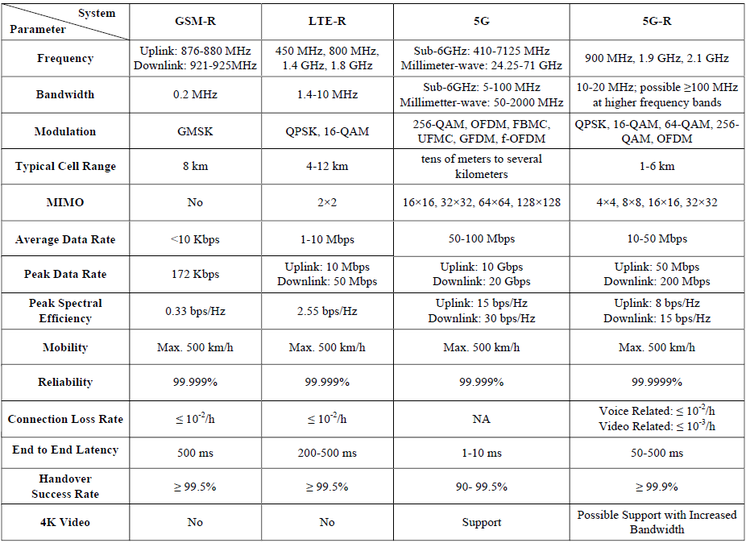
Ref: 5G for Railways: The Next Generation Railway Dedicated Communications)
A comparison of GSM-R, LTE-R, 5G, and 5G-R reveals that 5G-R outperforms existing railway communication systems. However, several challenges remain, including managing frequency resources, ensuring reliable, extensive data transmission, overcoming carrier penetration loss, and addressing Doppler Frequency Offset and Spread. Efficient multi-user group handover, enhancing perception analysis, intelligent decision-making, and the coexistence of broadband and narrowband technologies are also critical issues.
Conclusion
The rail industry is on the brink of significant technological advancements in networking, intelligence, and automation. The next-generation railway communication system must enable comprehensive perception, interconnection, and seamless information exchange among all railway users and infrastructures. Typical intelligent railway applications, such as video-based track monitoring, ultra-high reliability train control, and intensive access of massive users and sensors, align with the primary 5G scenarios: eMBB+, urLLC+ and mmTC+.
5G-R technology promises to revolutionize railway communication systems with its competitive performance, wide-ranging support for railway services, and adaptability to various application scenarios. Intelligent networking will play a crucial role in boosting 5G-R's performance and improving network services. The foundation of 5G-R will be built on several 5G-based technologies, such as network architecture, massive MIMO, millimetre-wave, multiple access, ultra-reliable low latency communication, and video processing.
To fully realise 5G-FRMC's potential, the technical challenges in its research and implementation must be addressed. This will pave the way for a more efficient, reliable, and intelligent railway communication system, setting the stage for the future of rail industry technology.
Here at Cyient Technology office, we offer engineering solutions and 5G connectivity to enable digitisation, automation, and cloud enablement from a railway’s life cycle management modernisation perspective. We enable FRCMS/5G network-based mechanisms to ensure the migration of traditional network loads, the transformation of copper line communication to optical digital technology adopting, DevSecOps - integtation of CI-CD-CT, deployment of SDN NFV VNF nodes, and Containerised communication mechanisms toward ensuring high productivity and reduce complexity. All these calls for higher degree for cyber security-based integration which is the foundation mark for these upgrades. At Cyient, we offer an C4E integrated offerings that ensures enhanced communication technology & security for rail domains as primary expertise runner.