Windows CE, a widely used operating system in embedded systems, has reached its end of life, compelling medical device manufacturers to transition to a new platform. This shift not only presents a set of challenges but also opens up a myriad of opportunities for the industry. As medical devices are integral to patient care, ensuring a smooth and efficient transition is paramount.
Windows CE End of Life: Impact on Medical Devices
Windows CE has been a widely used OS in the medical device industry due to its real-time capabilities, small footprint, and long-term support from Microsoft. However, with the cessation of support, the risks of continuing to use WinCE are too significant to ignore. These include:
- Security vulnerabilities: Without updates, devices running WinCE are susceptible to new security threats.
- Regulatory challenges: Unsupported OS platforms may not meet the stringent requirements of bodies like the FDA or EU MDR.
- Lack of technical support: As issues arise, manufacturers may find it difficult to resolve problems without official support.
Challenges in Transitioning from Windows CE
The transition from Windows CE brings several key challenges, including compatibility with existing systems, regulatory re-certification, data security concerns, and the need for staff training. These factors must be carefully managed to ensure a smooth shift to a new operating system without disrupting medical device performance or patient care. Here are the main challenges that manufacturers need to navigate during this transition.
1. Compatibility Issues
One of the primary challenges in transitioning from Windows CE is ensuring compatibility with existing hardware and software. Medical devices are often designed with specific operating systems in mind, and the shift to a new OS may necessitate significant reengineering. Compatibility issues can lead to increased costs and extended downtime, potentially impacting patient care.
2. Regulatory Compliance
Medical devices must meet stringent regulatory standards to ensure patient safety and efficacy. Transitioning to a new OS requires devices to undergo re-certification, a process that can be both time-consuming and expensive. Manufacturers must adhere to guidelines provided by regulatory bodies such as the FDA in the United States and the EMA in Europe, which involve rigorous testing and validation procedures.
3. Data Security
Data security is a critical concern in the medical field. Transitioning to a new OS means ensuring patient data is protected both during the migration process and afterward. The new platform must meet or exceed the security standards of Windows CE to prevent data breaches and comply with regulations such as HIPAA.
4. Training and Adaptation
Introducing a new OS will require extensive training for healthcare professionals and technical staff. Familiarity with the new system is vital to maintain operational efficiency and minimize errors. This training period may temporarily lower productivity and demand time and resource investments.
Opportunities in Adopting a New OS
Transitioning to a new operating system opens up significant opportunities for organizations. Enhanced performance, improved security features, and better integration capabilities offer a chance to boost efficiency and ensure more robust protection against evolving threats. Additionally, new operating systems provide greater scalability, allowing businesses to future-proof their operations and easily adapt to new technologies. This shift not only improves overall functionality but also supports long-term growth and sustainability. Here’s a closer look at the opportunities that come with this transition.
1. Enhanced Performance and Features
Modern operating systems offer enhanced performance and a plethora of new features compared to Windows CE. This transition provides an opportunity to leverage technological advancements to improve the functionality and efficiency of medical devices. Enhanced processing power, better user interfaces, and support for new applications can significantly enhance patient care.
2. Improved Security Measures
Newer operating systems come with improved security features that better protect sensitive medical data. Enhanced encryption, secure boot processes, and regular security updates help safeguard against cyber threats. Adopting a new OS can thus bolster the overall security posture of medical devices.
3. Interconnectivity and Integration
The modern healthcare ecosystem is becoming increasingly interconnected. Transitioning to a new OS can facilitate better integration with other medical systems and devices, enabling seamless data exchange. This interconnectivity can enhance diagnostic accuracy, streamline workflows, and improve patient outcomes by providing a comprehensive view of patient data.
4. Scalability and Future-Proofing
A modern OS is more likely to support future technological advancements, ensuring that medical devices remain relevant and functional for a longer period. This scalability allows manufacturers to implement new features and technologies as they emerge, extending the devices’ lifespan and reducing the need for frequent replacements.
Migration Options: Techniques and Considerations
Layered Approach: OS Abstraction Layer
This approach involves creating an OS abstraction layer that allows existing applications to run on top of a new OS, such as Linux, with minimal changes to the application code. The abstraction layer handles the differences between WinCE and Linux, making the transition smoother.
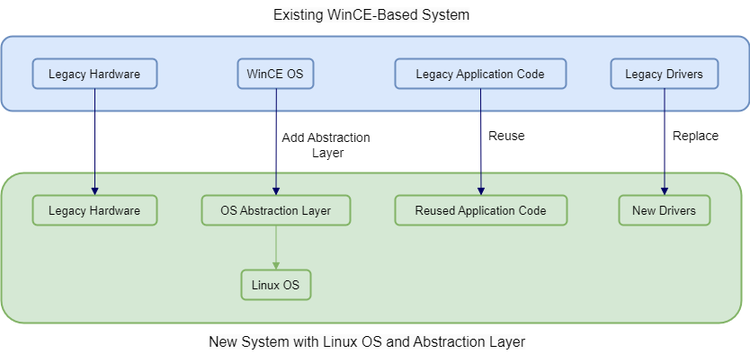
Abstraction Layer
Incremental Migration: Component-by-Component
Incremental migration involves gradually replacing components of the existing system with new ones compatible with Linux, while the core system remains operational. This technique allows manufacturers to migrate individual parts of the system, minimizing the risk of disruption.
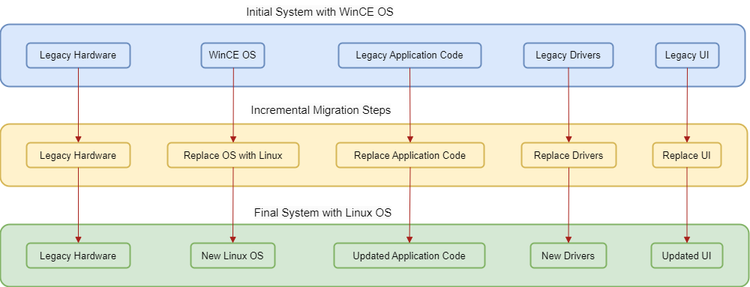
Incremental Migration: Component-by-Component
Selecting the Best Migration Approach: A Handy Guide
-
Aspect
- Migration Strategy
- Code Reuse
- Risk Management
- Time to Market
- Cost
- System Performance
- Maintenance and Updates
- Complexity
- Flexibility
- Regulatory Compliance
- Long-Term Viability
- Suitable Use Cases
- Example Scenario
-
Layered Approach with OS Abstraction Layer
- Introduces an OS abstraction layer to translate WinCE APIs to new OS.
- Most of the legacy application code can be reused with minimal changes, resulting in high compatibility.
- Lower initial risk, due to the abstraction layer, but potential long-term maintenance challenges.
- Faster initial migration, due to high code reuse and less disruption.
- Lower upfront costs due to code reuse, but potential higher long-term costs for maintaining the abstraction layer.
- Possible performance overhead due to the abstraction layer.
- Requires ongoing maintenance of the abstraction layer to keep it compatible with future OS updates.
- Simpler migration process initially, but adds complexity with the abstraction layer.
- Less flexible in terms of future development, tied to the abstraction layer.
- Easier initial compliance due to reuse of existing code.
- May require eventual removal of the abstraction layer for full migration to new OS, leading to potential rework.
- Ideal for systems where high code reuse is essential and rapid migration is needed.
- A device with tightly coupled WinCE-based application code needing a quick transition to Linux.
-
Incremental Migration: Component-by-Component
- Gradually replaces each component / subsystem with new OS compatible versions.
- Each component may require significant updates or rewrites, resulting in moderate compatibility.
- Moderate risk, incremental approach allows for early identification of issues, but more components are directly affected.
- Slower, as each component is migrated individually, but may be more controlled.
- Potentially higher costs due to the need for updating or rewriting multiple components. Spread out over time.
- Typically, better performance, as each component is optimized for new OS.
- Maintenance aligns with standard OS practices, easier to update individual components.
- Higher complexity during migration due to the need to manage dependencies between components.
- High flexibility, as each component can be independently updated or replaced.
- More granular re-certification process, easier to comply with specific regulations for each component.
- More sustainable long-term solution, as the entire system is fully migrated to new OS.
- Suitable for complex systems with multiple subsystems, where gradual migration is necessary.
- A medical imaging device with complex, interdependent subsystems requiring careful migration.
Key Considerations for a Successful Migration
Manufacturers must carefully consider several factors to ensure a smooth transition:
- Compatibility Testing: Thorough testing is required to ensure that existing hardware and software components work seamlessly with the new OS. This includes verifying driver support, peripheral compatibility, and integration with existing software.
- Security Hardening: Given the critical nature of medical devices, robust security measures, such as encryption, access controls, and regular security audits are essential to implement. Manufacturers should also establish processes for timely updates and patches.
- Regulatory Re-Certification: Migrating to a new OS will likely necessitate re-certification of the device. Engaging with regulatory bodies early in the process can help navigate this complex and time-consuming aspect of the migration.
- User Training and Support: Medical devices are often used by healthcare professionals without technical expertise. Ensuring the new system is user-friendly and providing adequate training and support are crucial to avoid disruptions in clinical environments.
Conclusion
The end of life for Windows CE marks a significant transition period for medical device manufacturers. While the challenges of compatibility, regulatory compliance, data security, and training are substantial, the opportunities for enhanced performance, improved security, better integration, and future-proofing make this transition a worthwhile endeavor. By carefully planning and executing the migration to a new OS, medical device manufacturers can not only overcome the challenges but also take advantage of the numerous benefits that modern operating systems offer.
In navigating this transition, collaboration with regulatory bodies, investment in training and development, and leveraging case studies of successful migrations can provide valuable insights and guidance. Ultimately, the shift from Windows CE to a new OS can drive innovation and improvement in the medical device industry, leading to better patient care and outcomes.
We recommend transitioning from Windows CE to Linux-based operating systems, as Linux offers a stable, secure and customizable platform that can be tailored to specific needs. By adopting to Linux, we can achieve better performance, enhanced security, and reduced licensing costs. The open-source nature of Linux also allows for greater flexibility and innovation.