
Telecom operators are investing billions in 5G infrastructure, but the key question remains: how can they turn that investment into sustainable revenue?
For years, operators have struggled with the “dumb pipe” problem, providing connectivity while others captured most of the value. With 5G Standalone and the Network Exposure Function (NEF), that dynamic is changing.
By exposing network capabilities as secure APIs, operators can transform their networks into programmable platforms. Third-party applications can request Quality of Service (QoS), device location, session control, or even fraud-prevention signals in real time.
This marks a pivotal shift from technical innovation to commercial transformation. The crucial question is whether operators can monetize these capabilities before hyperscalers, and aggregators dominate the market.
How Operators can Make Money From 5G APIs
Traditionally, operators have earned revenue through subscriptions and capacity sales. Network exposure introduces new monetization models that resemble cloud economics more than traditional telecom.
- Transactional APIs: Operators can charge per API call, similar to cloud services. For example, a location check or QoS boost may cost fractions of a cent, but these add up significantly at scale.
- Tiered Service Bundles: APIs can be packaged into industry-specific tiers such as bronze, silver, or gold. A hospital might subscribe to a platinum bundle that offers guaranteed latency, identity verification, and priority access.
- Revenue-sharing ecosystems: Through GSMA Open Gateway, CSPs can partner with banks, media companies, or IoT providers, and share revenue generated from API usage.
- Usage-Based Network Slicing: Enterprises can pay for short-term network slices provisioned through APIs, effectively turning network infrastructure into a metered utility.
These models move operators toward becoming true digital platforms. The challenge is scaling these offerings fast enough to stay ahead of hyperscalers and shape the future of API marketplaces. Ultimately, this is where 5G API monetization will be won or lost.
Why Developers and Third Parties Suddenly Care
For developers, APIs are essential building blocks. Yet many have never interacted directly with telecom networks. NEF changes that by offering network intelligence and control as code.
- Monetizing User Experience: Game developers can introduce premium tiers where NEF APIs ensure latency below 20 milliseconds. Video apps can guarantee high-definition streaming during peak hours.
- Creating New Applications: Drones with centimeter-level precision, AR concerts with synchronized latency, and industrial IoT systems with dynamic QoS all become possible through network APIs.
- Simplifying Integration: Developers can access APIs programmatically, eliminating the need for lengthy contract negotiations and reducing time-to-market from months to hours.
- Scaling globally: The CAMARA Project federation (an app built in Spain) enables cross-operator API federation, allowing apps built in one country to use the same APIs in others without reintegration. For example: The project can plug into the same APIs in Brazil or Japan without reintegration. Adoption is still evolving, but the goal is seamless cross-operator reach.
Third parties, meanwhile, can purchase raw APIs, bundle them into vertical solutions, and sell them at a premium. The winners will be those who can translate complex telecom capabilities into developer-friendly offerings.
Consider a startup building an AR gaming platform. By integrating NEF QoS APIs, it can guarantee ultra-low latency during matches and introduce a “pro” tier for players who want a lag-free experience. The startup earns from subscriptions, and the operator earns from API consumption, a win-win monetization model.
The Role of Northbound APIs
The 3GPP Northbound Interface (NBI) is a critical component of 5G API monetization. It acts as the bridge between the network and external systems, ensuring abstraction, security, and consistency. Whether in Tokyo or Madrid, an API for QoS or location behaves predictably when standards are applied.
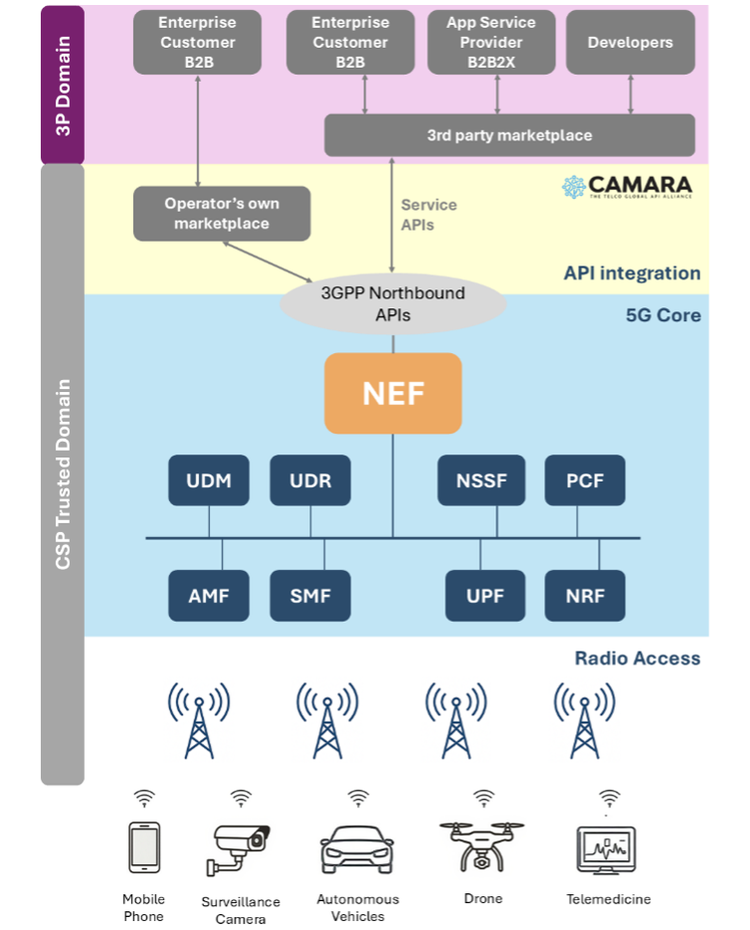
NEF at the heart of 5G Core Exposure Capability
Through the NEF, developers interact with a clean, standardized interface without needing to understand complex network functions like AMF or UPF. The NEF enforces authentication, throttling, and compliance, allowing APIs for QoS, location, and session management to behave predictably across operators.
Commercially, this standardization is vital. Without NBI, developers would need bespoke integrations for each operator, an unscalable approach. With it, initiatives like Open Gateway and CAMARA can aggregate APIs globally, enabling broader reach and interoperability.
A key strategic question remains: should operators monetize Northbound APIs directly, maintaining control over customer relationships, or will aggregators take a share of the profits? This debate lies at the heart of 5G API monetization.
Case Studies: Monetization in Action
This isn’t just theory... operators and vendors are already making it real:
- Vodafone collaborated with banks to launch the Scam Signal API, which flags fraudulent calls before they connect. This reduces financial fraud while generating API revenue for Vodafone.
- Nokia developed the Network as Code platform, simplifying developer access to network APIs and enabling CSPs to monetize through licensing and usage.
- Telefónica introduced Quality on Demand and Device Location APIs in Spain, offering enterprises predictable latency and precise tracking as paid services.
These cases show that 5G monetization is already driving measurable business outcomes.
Challenges: Trust, Standards, and Operational Complexity
The potential is real, but operators face several hurdles before APIs become mainstream revenue engines:
- Trust is non-negotiable Enterprises will only adopt APIs if they trust the data and exposure controls. Strong frameworks like OAuth2, OpenID Connect, and CAPIF enforcement must be treated as core infrastructure. Huawei’s research highlights the importance of auditing, authentication, and anonymization to reinforce enterprise trust.
- Standardization is incomplete 3GPP standards (TS 29.522) and (TS 23.288) provide the foundation, but alignment with GSMA Open Gateway and CAMARA remains work in progress. Until this converges, developers face fragmentation (different operators, different APIs), which slows adoption and undermines global scale.
- Operational complexity Monetization requires SLA enforcement, real-time charging, and dynamic orchestration. According to research by Nokia’s 6G orchestration, future solutions will likely rely on AI and machine learning for self-optimizing networks that adapt in milliseconds, making large-scale API exposure cost-effective.
- Pricing uncertainty Pricing strategies are still evolving. Operators must balance affordability with profitability to avoid commoditizing APIs.
- Hyperscalers competition Cloud giants already aggregate operator APIs into single integration points for developers. This convenience, combined with their global scale, could easily sideline CSPs. To stay competitive, operators need to unite and stand out by emphasizing trust, compliance, and regulatory-grade services or risk losing the majority of API revenue to the hyperscalers.
The Role of Strategic Partners Like Cyient
NEF monetization is transitioning from concept to commercial reality. Operators like Vodafone, Telefónica, Nokia, and Ericsson are already deploying APIs, but most enterprises still lack the technical expertise to consume them effectively. This is where partners like Cyient play a critical role.
Cyient combines 5G Core expertise with software and automation skills to turn APIs into business value. Its helps by:
- Simplifying complex 3GPP APIs into enterprise-friendly interfaces
- Automating workflows to integrate QoS, location, and security APIs into IT systems
- Bridging telecom and cloud ecosystems (AWS, Azure, GCP) through developer tools and SDKs
- Building industry-specific use cases such as telemedicine guaranteeing low latency, smart logistics boosting QoS on demand, and fraud prevention
In doing so, Cyient becomes the translator and enabler of the API economy. It helps both operators and developers realize the commercial potential of 5G APIs.
Ultimately, the future of 5G monetization will depend on collaboration among operators, developers, and ecosystem enablers. Operators provide the infrastructure, developers create innovation, and companies like Cyient bridge the gap between them.
The real question is whether operators will partner with enablers to accelerate adoption or choose to go it alone in shaping the future of 5G monetization.