
The advent of the fifth generation of mobile communications (5G) is paving the way for the fourth industrial revolution, enabling digital transformation across vertical industries such as farming, healthcare and industrial production. Private networks offer a tailored approach to meeting the specific requirements of these industries, such as latency, throughput, and device density. While private network implementation can be complex, this blog aims to simplify key concepts and trade-offs, presenting practical use cases that demonstrate the value of 5G private networks.
What are 5G Private Networks?
Mobileprivate networks are not a recent concept; they have evolved since the launch of 2G/3G, and later 4G. The introduction of 5G has sparked renewed interest due to its ability to meet the demanding requirements of vertical industries and Internet of Things (IoT) applications. Compared to 4G, 5G networks offer significant advantages in both the radio interface and system-level architecture.
- Radio Interface: 5G enables spectrum flexibility, high data rates (up to Gbps), ultra-low latency, and massive connectivity.
- System-Level Architecture: 5G supports network slicing, enhances security, and facilitates broader global adoption.
Unlike public networks, private networks allow enterprises to deploy applications and services with dedicated infrastructure, offering greater control, security, and customization.
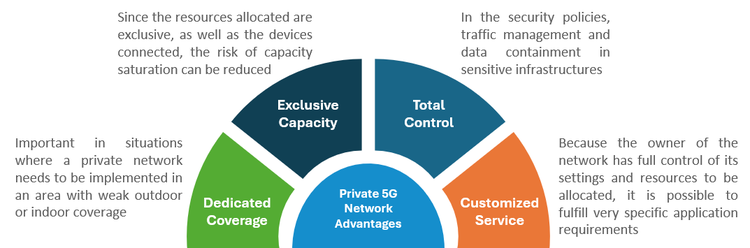
Figure 1 - Private 5G network advantages, adapted from [1].
It should be noted that the advantages mentioned in Figure 1 can be conditioned by other factors such as implementation modes and spectrum type, which can limit some options for customization, control and security, with the added benefit of reduced financial costs and implementation time. If these advantages are to be optimized, a higher financial cost and longer implementation time will be required.
Implementation Modes for Private Networks
Private 5G networks can be deployed in two primary modes:
- Standalone Mode – The network operates as a completely isolated system, independent from the public networks This allows maximum control but requires higher initial investment in terms of hardware and maintenance costs.
- Integrated Mode – The network shares some infrastructure with a public network, reducing costs and complexity while offering fewer customization options.
Types of Spectrum for 5G private networks
5G private networks can utilize different spectrum types, each with distinct trade-offs:
- Licensed Spectrum – Obtained from mobile network operators, ensuring high performance and minimal interference.
- Unlicensed Spectrum – Available for free use (e.g., 2.4 GHz, 5 GHz, 6 GHz), but susceptible to interference and security risks.
- Shared Licensed Spectrum – Allocated by regulatory bodies, providing a balance between accessibility and performance guarantees. Examples include the 3.5 GHz band in the United States and the 3.7 GHz to 3.8 GHz in Germany. This spectrum type allows network deployments without relying on mobile network providers while implementing the mechanisms to minimize interference.
Use cases for Private Networks
5G private networks are transforming multiple industries by offering customized solutions.
Key use cases include:
Figure 2 - Private 5G network use cases, adapted from [2].
- Healthcare – Supports remote surgeries requiring ultra-low latency and high data rates for real-time, high-resolution video streaming.
- Smart Parking – Enhances traffic management by using sensors to detect available parking spots integrating with mobile applications for real-time updates.
- Smart Agriculture – Deploys sensors to monitor the crop health, predict harvest times, and optimize resource usage.
- Smart Mining – Enables remote operation of safety-critical infrastructure in hazardous environments, improving safety and efficiency.
- Railways – Enhances train-to-ground communications for operational control and passenger connectivity.
- Smart Street Lights – Utilizes sensors in light poles for adaptive lighting, reducing energy consumption based on real-time conditions.
Case Study: Smart Street Lighting
A study conducted by Cyient in the article “Dimensioning and Simulation of 5G Private Networks”, presented at the 18th URSI/ANACOM Congress in Lisbon, Portugal [3], explored the deployment of a private 5G network for smart street lighting. The study followed four key steps:
- Use case definition – Analyzed technical requirements for smart street lighting use case;
- Dimensioning – Configured 5G parameters, including bandwidth, power settings, and other propagation variables. Link budget calculations were performed to determine the required signal strength dependent on the quality of service.
- Planning – Identified optimal base station placement based on a hexagonal grid created from the link budget results;
- Coverage Simulation – Evaluated signal strength and adjusted configurations to achieve 99.55% coverage in a 16 km² area of Lisbon using six base stations. Simulations considered factors such as terrain effects, building penetration loss, and device density.
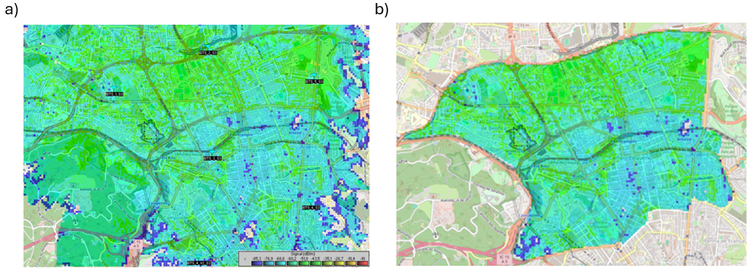
Figure 3 – Smart Street Lighting Coverage Map: a) original coverage; b) cropped coverage, adapted from [2].
Final Remarks
5G private networks offer organizations increased control, security and performance, making them essential for industries such as smart cities, healthcare, and agriculture. By leveraging private networks, businesses can tailor network configurations to their specific needs, ensuring high reliability and efficiency. As the technology evolves, continuous monitoring of key performance indicators will be crucial to maximizing the benefits of private 5G networks.
References
- A. Aijaz, “Private 5G The Future of Industrial Wireless”. in IEEE Industrial Electronics Magazine, vol. 14, no. 4, pp. 136-145, Dec. 2020, doi: 10.1109/MIE.2020.3004975.
- R. Sousa, “Dimensionamento e Simulação de Redes Privadas 5G”, Master thesis, Instituto Superior de Engenharia de Lisboa, 2024.
- R. Sousa, M. Pereira, P. Vieira, “Dimensionamento e Simulação de Redes Privadas 5G”. 18th Congress of the Portuguese Committee of URSI/ANACOM, Lisbon, Portugal.
- Instituto de Telecomunicações, “Best Student Paper Awardees at the XVIII Congress of the Portuguese Committee of URSI” 2024, [Online]. Available: https://www.it.pt/News/NewsPost/5067