The Strategic Role of Root Cause Analysis In AIOps
In a market defined by razor-thin margins and rising energy costs, Mobile Network Operators (MNOs) are under relentless pressure to improve operational efficiency while controlling expenditures. Automation, driven by Artificial Intelligence for IT Operations (AIOps), is becoming a vital lever—streamlining complex, manual tasks throughout the network lifecycle.
Among the most critical applications of AIOps is event correlation and root cause analysis, which enables operators to swiftly identify and address the underlying drivers of faults and performance degradation. Simultaneously, the demand for energy sustainability in wireless networks has intensified. Energy usage not only constitutes a major operational expense but also contributes significantly to the carbon footprint. As the demands for service reliability and energy efficiency increasingly overlap, the need for intelligent, causally informed systems becomes critical.
To restore service and optimize energy use, operators must move beyond reactive troubleshooting. Instead, they need precise, timely identification of root causes that inform actionable, sustainable interventions.
Why Traditional Correlation Methods Are Not Enough
While explainable AI (XAI) tools such as SHAP values and feature importance rankings have advanced our ability to interpret ML models, they are not sufficient for driving decisions in real-world wireless networks. These tools operate on a critical assumption: that the ML model encapsulates the entire data-generating process.
In reality, mobile networks are shaped by dynamic interactions, latent dependencies, and hidden confounders. These complexities render simple statistical correlations unreliable and potentially misleading. This is especially true in energy optimization scenarios, such as improving the efficiency of mobile Base Stations (BSs). In such cases, decisions must be causally sound, not just statistically significant.
To enable sustainable decision-making, MNOs require more than correlations, they need to understand the causal mechanisms that underpin network behavior.
Introducing The Energy Sustainability Causal Framework (ESCF)
To address this gap, Cyient developed a novel methodology that blends data science, telecommunications engineering, and causal reasoning: the Energy Sustainability Causal Framework (ESCF). This work was recently published in an article titled Integrating Machine Learning and Observational Causal Inference for Enhanced Spectral and Energy Efficiency in Wireless Networks in IEEE Access, where we outlined the framework in detail and showed how causal inference and machine learning can work together to uncover the real drivers of energy performance. The publication reinforces the rigorous methodology behind the ESCF and validates its value as a guide for more sustainable, evidence-based network decisions.
This framework builds upon earlier work on the Energy Sustainability Class (ESC) metric—a composite indicator that classifies BSs into four categories (A, B, C, D) based on their joint spectral and energy efficiency. While this metric provides a high-level view of energy performance, the ESCF digs deeper to uncover the true drivers of these classifications. The ESCF unfolds in three stages:
-
Exploratory Analysis with Machine Learning
The process begins with training ML models to identify variables that show strong statistical associations with ESC outcomes. This helps narrow the field of investigation to the most influential features.
Causal Graph Construction with Expert Insight
Next, a Directed Acyclic Graph (DAG) is built in collaboration with network experts. This graph formalizes domain knowledge and hypothesizes cause-effect relationships between variables. It acts as a blueprint to identify confounders—variables that can distort causal conclusions if not properly accounted for.
Figure 1 below illustrates such a causal graph. It includes over 30 nodes representing network indicators like downlink interference, MIMO activity, and PRB usage. Arrows represent presumed causal links informed by expert input, while node colors indicate different network scopes.
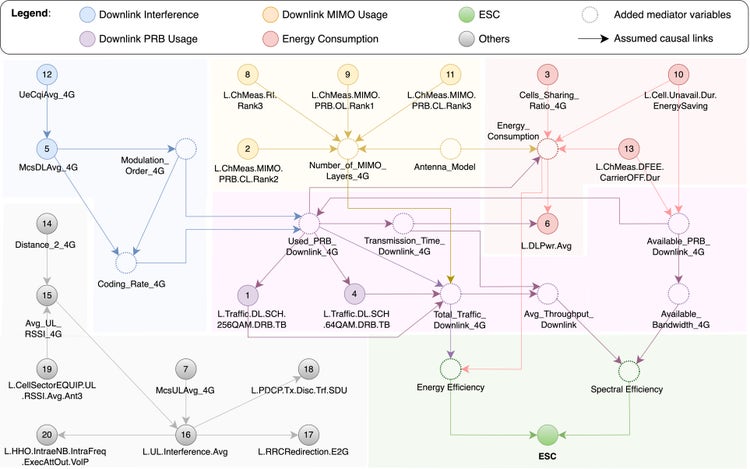
Fig. 1 – Causal Graph showing expert-validated dependencies between PM and EM indicators
-
Observational Causal Inference
Finally, the framework applies observational causal inference techniques to quantify the effect of selected variables (treatments) on ESC outcomes. Methods like Inverse Probability of Treatment Weighting (IPTW) and Propensity Score Matching (PSM) simulate a counterfactual environment allowing the framework to estimate how the ESC would change under hypothetical interventions, while holding confounding factors constant.
Causes Quantifying The Causal Impact Of Downlink Interference
To validate the ESCF, Cyient tested it using real-world data from a commercial 4G/5G network. The focus: understanding how downlink radio quality, measured via the Channel Quality Indicator (CQI), impacts the likelihood of a BS being classified as ESC A.
Using Marginal Structural Models (MSMs), a robust causal inference technique for time-varying treatments—the team discovered a compelling result: increasing the average CQI by one unit yields an 11-percentage point rise in the probability that a BS is rated as ESC A.
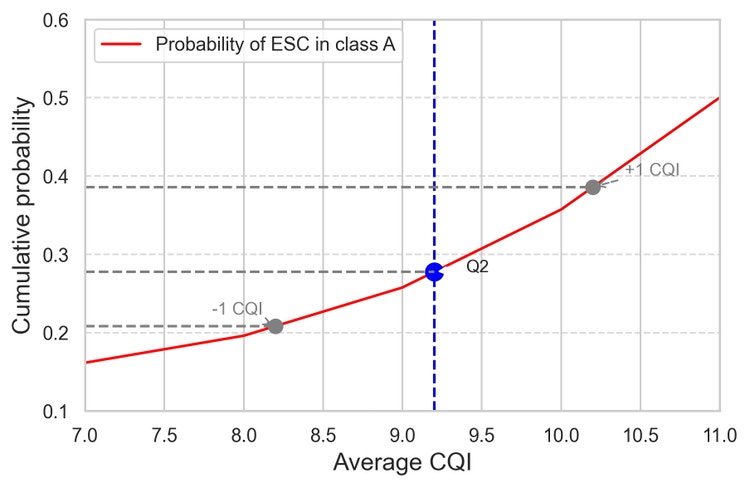
Fig. 2 – Causal effect of average CQI on the probability of achieving ESC A classification
This finding not only validates the intuitive link between better radio conditions and improved energy efficiency, but also establishes it with causal precision. It highlights the measurable impact that targeted enhancements in network quality can have on advancing sustainability objectives.
A Blueprint For Causally Informed Network Optimization
The ESCF is not merely a technical advancement—it marks a fundamental shift in how mobile network operations can be understood and optimized. By grounding decisions in causal inference rather than statistical correlation, MNOs are empowered to:
- Maximize energy efficiency without compromising service performance
- Implement targeted, evidence-based interventions that drive measurable outcomes
- Systematically untangle complex dependencies using expert-informed causal structures
As mobile networks evolve to meet both connectivity demands and sustainability goals, causality becomes a critical enabler. It provides the analytical clarity needed to make confident, forward-looking decisions. In this new paradigm, causal reasoning is a foundational requirement for building mobile networks that are resilient, efficient, and intelligently adaptive to future demands and sustainability challenges.