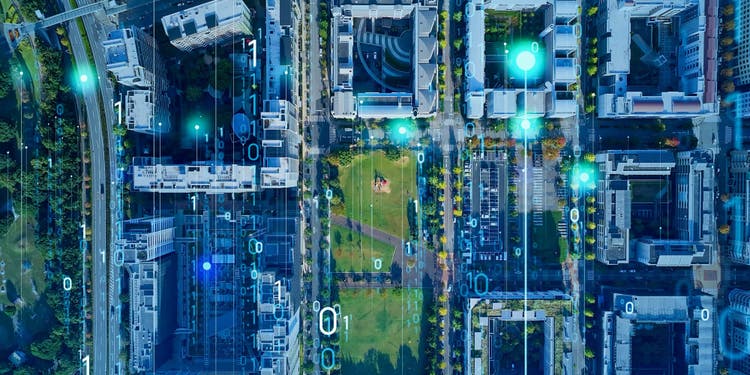
Spatial Digital Twin (SDT) technology is transforming the geospatial industry by providing interactive, data-driven representations of real-world environments with precise geospatial context. These dynamic virtual replicas of physical assets, infrastructure, or entire urban ecosystems integrate diverse spatial data sources such as satellite imagery, IoT sensor data, LiDAR scans, and GIS mapping. By enabling high-precision 3D modeling enriched with geospatial intelligence and real-time analytics, Spatial Digital Twins enhance data accuracy, usability, and decision-making capabilities. Organizations leveraging these advanced digital models can optimize infrastructure planning, improve asset performance, and make informed decisions.
Advancements in Spatial Digital Twins
The evolution of AI, Big Data, IoT, and Cloud Computing has accelerated the adoption of 4D Spatial Digital Twins, making them a critical component of smart city planning, risk assessment, and infrastructure optimization. 4D Spatial Digital Twins incorporate the fourth dimension—time—allowing for real-time updates and simulations that help predict future trends in urban development and infrastructure. These intelligent models integrate real-time sensor inputs with historical data, offering interactive simulations that empower industries with accurate, data-driven insights.
As the technology continues to advance, its integration with Augmented Reality (AR), Virtual Reality (VR), Artificial Intelligence (AI), Machine Learning (ML), and cloud computing is redefining urban development, industrial automation, and infrastructure management. This convergence is driving the next generation of smart cities by enhancing operational efficiency, reducing environmental impact, and streamlining city planning. Consequently, Spatial Digital Twins are emerging as the backbone of future geospatial intelligence and digital transformation.
Seamless Integration of AR and VR in Spatial Digital Twins
Spatial Digital Twins combine geospatial data, IoT sensor inputs, and real-time analytics to create highly accurate 3D or 4D virtual representations of physical environments. When integrated with AR and VR, they provide immersive, data-driven insights that revolutionize industries such as urban planning, manufacturing, defense, and infrastructure management.
Augmented Reality Workforce Solutions
Extended Reality (XR), which encompasses AR, VR, and Mixed Reality (MR), enhances Digital Twins by enabling real-time visualization, interaction, and predictive simulations. XR technologies bridge the physical and digital worlds, allowing users to remotely monitor, inspect, and collaborate on complex assets and infrastructure.
- Game Engines & Visualization Tools: Unity and Unreal Engine support geospatial data integration through platforms such as Cesium, Mapbox, and OpenStreetMap, enabling real-time 3D visualization and high-fidelity rendering.
- Geospatial Software: Cesium, Google Earth VR, and QGIS facilitate 3D terrain mapping, photogrammetry, and LiDAR visualization, making them invaluable for urban planning and AR applications.
- 3D Modeling & CAD Tools: Autodesk Revit, Bentley Systems, and Blender integrate with NVIDIA Omniverse to create immersive experiences for architecture, infrastructure, and city modeling.
- Cloud & AI-Powered Solutions: AWS Spatial Computing, OpenXR, and Google ARCore enable scalable XR computing, supporting mobile AR applications and geospatial analytics.
- Web-Based XR Platforms: WebXR and Potree facilitate browser-based XR experiences, including LiDAR visualization and AR city navigation.
The Impact of Digital Twin Technology: Transforming Industries with AR & VR
Among the key innovators in this space, Cyient is at the forefront of integrating AR, VR, and Digital Twin technologies to solve real-world challenges. By leveraging spatial computing and immersive solutions, Cyient enhances training, maintenance, and operational efficiency across multiple sectors. Cyient’s work in various sectors demonstrates the transformative power of AR and VR. Whether it’s medical training in the healthcare sector or rail infrastructure maintenance, these immersive technologies are streamlining operations, improving safety, and enhancing efficiency across industries.
- Healthcare Sector: Cyient collaborated with a leading eye institute in India to develop a Mixed Reality training environment using Microsoft HoloLens. This immersive approach transformed traditional 2D learning methods into interactive 3D experiences, allowing medical professionals to explore eye anatomy at a cellular level. The MR training significantly improved medical education, professional training, and knowledge retention.
- Rail Industry: AR and VR technologies have optimized the design, construction, and maintenance of railway infrastructure. Engineers can assess and modify designs in virtual environments through VR-driven design visualization, reducing reliance on physical prototypes. Additionally, AR-assisted assembly procedures offer step-by-step visual guidance, enhancing quality control and remote inspections. These technologies have resulted in improved operational efficiency and safety standards.
Advancing Workforce Training with Augmented Reality
Cyient plays a crucial role in the aerospace and defense industries by integrating AR and VR for training and maintenance operations. These technologies enable personnel to gain a deeper understanding of complex defense systems through virtual simulations and interactive 3D models. By enhancing training efficiency and streamlining maintenance procedures, AR and VR have led to cost reduction and increased workforce productivity in these high-precision industries.
Virtual Reality Training in Industry 4.0 and Smart Manufacturing
As part of Industry 4.0, Cyient combines AR/VR with AI to develop advanced digital twin solutions. AR is used to train employees in equipment maintenance through simulated environments, while VR enables process visualization, improving planning and execution. These innovations enhance safety, reduce costs, and optimize industrial operations, making manufacturing processes more intelligent and automated. A leading energy company in India faced challenges in training maintenance technicians due to outdated methods that led to errors, downtime, and increased operational costs. Cyient introduced a VR-powered training module, allowing technicians to simulate real-world machinery in a controlled environment. This immersive training improved skill retention and reduced errors. Additionally, AR-assisted maintenance solutions provided real-time, hands-free support through visual checklists and step-by-step guidance, leading to faster repairs, reduced downtime, and enhanced safety protocols.
Watch Cyient's AR Maintenance Training Video
The integration of AR and VR across industries has resulted in significant benefits such as increased productivity, improved quality control, and streamlined knowledge sharing. Real-time expert connectivity has facilitated collaborative learning and quicker problem-solving, setting new industry standards in training, maintenance, and operational efficiency.
Conclusion
With its expertise in Spatial Digital Twin innovations, Cyient continues to work with AR and VR-powered geospatial applications. By leveraging AI, IoT, and 5G, Cyient is shaping the future by optimizing infrastructure, improving workforce efficiency, and streamlining industrial production. These advancements are driving the transformation of smart industries, ensuring sustainability, efficiency, and innovation in the digital era.